
The debate around self-publishing vs traditional publishing has never been more relevant than it is today, especially for authors who are thinking beyond the launch day and focused on building sustainable, long-term income from their work. Both paths have produced successful careers, millionaire authors, and complete financial disappointments. The difference almost always comes down to goals, timing, and understanding.
We have worked with authors across both publishing models, and what we consistently find is that the right choice is rarely obvious without a thorough book publishing comparison. This guide breaks down exactly how the two paths diverge across royalties, control, costs, and long-term revenue potential so you can make the most informed decision for your career.
Inside This Book Publishing Comparison
Here is a quick overview of everything this blog walks you through.
- How royalty structures differ between self-publishing and traditional publishing
- The real upfront costs and gatekeeping realities of each path
- What long-term rights and creative control mean for your revenue
- How the traditional publishing process works from query to bookshelf
- A side-by-side book publishing comparison to clarify your options
- Which path makes more financial sense, depending on your specific goals
Understanding the Two Paths Before Comparing Them
Before diving into numbers, it helps to understand what each model fundamentally represents. Self-publishing puts you in the role of both author and publisher. You make every creative and business decision, bear every cost, and keep the majority of the revenue. Traditional publishing transfers much of that responsibility to a publisher in exchange for a smaller share of earnings and a slower path to market.
Neither model is inherently superior. The self-publishing vs traditional publishing question is really a question about what you value most as an author and as a business. Speed, control, and higher royalties favor one path. Prestige, infrastructure, and upfront advances favor the other. Understanding where your priorities sit is the foundation of any smart book publishing comparison.
Royalty Rates and What You Actually Earn Per Book
This is where the numbers tell the most revealing story. The gap between what self-published and traditionally published authors earn per unit sold is significant, and it compounds dramatically over time.
Self-Publishing Royalties
On platforms like Amazon KDP, self-published authors typically earn between 60 and 70 percent of revenue on ebooks and paperbacks. For a paperback priced at fifteen dollars, that translates to roughly four to seven dollars per copy sold. You earn this from the very first sale, with no advance to recoup and no waiting period before royalties flow.
Traditional Publishing Royalties
Traditional publishers typically offer authors between 5 and 15 percent royalties on net print sales and around 25 percent on ebooks. For that same fifteen-dollar book, a traditionally published author might earn as little as one dollar and fifty cents per copy. That money is also withheld until the advance earns out, meaning the publisher recoups what they paid you upfront before you see any additional income.
The Royalty Comparison at a Glance
|
Revenue Factor |
Self-Publishing |
Traditional Publishing |
|
Ebook Royalty Rate |
60 to 70 percent |
Around 25 percent |
|
Print Royalty Rate |
60 to 70 percent |
5 to 15 percent |
|
Earnings on a 15 Dollar Book |
4 to 7 dollars |
1 to 2 dollars |
|
Advance Required to Earn Out |
No advance |
Yes, must earn out first |
|
Royalty Payment Timeline |
Monthly |
Twice yearly after earnout |
The math here strongly favors self-publishing when it comes to per-unit earnings. However, the traditional publishing process can deliver volume through established retail distribution that independent authors often struggle to replicate on their own.
Upfront Costs vs Gatekeeping
The financial picture for each path includes not just royalties but also what you spend to get there. The self-publishing vs traditional publishing comparison looks very different depending on which side of the cost equation you examine.
What Self-Publishing Costs You
Self-publishing requires you to fund every element of production. That includes professional editing, cover design, interior formatting, and marketing. These prices can range from thousands of dollars for a basic production to significantly more for premium services across all categories.
The advantage is that you earn royalties from day one without needing approval from anyone. Investing in professional book publishing support from the start is one of the smartest ways to ensure your self-published book competes with traditionally published titles on quality alone.
What Traditional Publishing Costs You
Traditional publishing absorbs all production costs. The publisher pays for editing, cover design, layout, printing, and distribution. In exchange, you accept lower royalties and hand over significant creative control for the duration of your contract.
The real cost of traditional publishing is not financial. It is time and access. The traditional publishing process requires querying literary agents, waiting for responses that can take months, and then navigating the submission process to publishing houses. The entire journey from query letter to bookstore shelf can easily take two to three years.
The Gatekeeping Reality
Traditional publishing is highly selective. A literary agent might receive thousands of queries per year and sign fewer than a dozen new clients. Getting past that gate requires not just a compelling book but also a polished query letter, a professional book proposal, and often an existing platform or audience.
Self-publishing has no gatekeepers. That is both its greatest strength and its greatest challenge. Anyone can publish, which means quality varies wildly, and discoverability becomes a major responsibility that falls entirely on the author.
Long-Term Rights and Creative Control
The self-publishing vs traditional publishing debate becomes most pronounced when you look at who owns what and for how long. This is the area where the long-term revenue implications are most significant.
Self-Publishing and Intellectual Property
When you self-publish, you retain full ownership of your intellectual property indefinitely. You can change your pricing at any time, update the cover, release new editions, adapt the content for other formats, and build an entire product ecosystem around your book without asking anyone’s permission. This ownership compounds in value as your catalog grows.
Authors who build a strong catalog of self-published titles create a passive income stream that grows with every new release. Each book supports the others through reader cross-promotion, and the author captures the full financial benefit of that ecosystem.
Traditional Publishing and Rights Licensing
When you sign with a traditional publisher, you license your rights to them for a defined period. The specific terms vary by contract, but publishers typically control print rights, digital rights, audio rights, and sometimes translation and adaptation rights. If the book underperforms commercially, publishers may let it go out of print while still holding the rights, leaving the author unable to release a new edition independently.
Rights reversion clauses exist in most contracts, but negotiating them requires a skilled literary attorney or agent and a clear understanding of what triggers the reversion. Many first-time authors sign contracts without fully understanding the long-term implications of what they are giving up.
For authors in specialized niches, working with services designed for specific publishing goals can simplify the rights management process. For example, authors looking to reach listeners through Audible publishing platforms can retain full audio rights as independent publishers, a flexibility that traditional contracts often restrict.
The Traditional Publishing Process Explained
Understanding the traditional publishing process is essential for any fair book publishing comparison. Many authors romanticize this path without fully understanding what it involves in practice.
Step 1. Writing and Polishing the Manuscript
Before querying, your manuscript must be completely finished and professionally polished for fiction. Nonfiction authors typically query with a detailed book proposal and sample chapters. Either way, submitting anything less than a fully refined manuscript is a fast path to rejection.
For authors developing commercial fiction before entering the traditional publishing process, learning how to hire a ghostwriter for a novel can help clarify how professional collaboration fits into manuscript development.
Step 2. Querying Literary Agents
Most traditional publishing opportunities begin with a literary agent. You cannot submit directly to most major publishing houses without agent representation. The query process involves writing a compelling one-page letter that summarizes your book, your credentials, and why it belongs in the market.
Researching agents who represent your specific genre is critical. Submitting to agents who do not work in your category wastes everyone’s time and closes doors.
Step 3. Agent Submission to Publishers
Once an agent signs you, they pitch your book to acquisitions editors at publishing houses. This process can take months and may involve multiple rounds of submission before finding the right fit. If a publisher offers, the agent negotiates the contract terms, including the advance, royalty rates, and rights.
Step 4. Publication Timeline
After signing a deal, most traditionally published books take 12 to 18 months to reach shelves. Editorial revisions, cover design, catalog positioning, and distribution logistics all take time within a large publishing organization. By the time your book launches, it could be two to three years after you first started querying.
Book Publishing Comparison for Different Author Goals
The smartest approach to this decision is matching the publishing model to your specific goals rather than assuming one path fits all authors.
When Self-Publishing Makes More Sense
- You want higher per-unit royalties and faster time to market
- You write in a genre with a strong self-publishing ecosystem, like romance, fantasy, or thriller
- You are building a multi-book series where volume and speed of release matter
- You want full creative control over cover design, pricing, and content
- You are building a business around your books rather than treating writing as a prestige endeavor
Authors in the business and entrepreneurial space often find that business ghostwriting and self-publishing combined give them the fastest path to using a book as a credibility and marketing tool without waiting years for a traditional deal.
When Traditional Publishing Makes More Sense
- You are targeting physical bookstore placement as a primary sales channel
- You value the prestige of a major imprint for career or speaking opportunities
- You secure a substantial advance that justifies the lower long-term royalty rates
- You write in a category where traditional publishing still dominates, such as literary fiction or academic nonfiction
- You want a professional editorial and marketing team handling production without an out-of-pocket investment
The Hybrid Strategy
Many experienced authors use both models strategically. They might self-publish early titles to build an audience and proof of concept, then leverage that track record to negotiate a traditional deal with stronger terms. Others publish with a traditional house for flagship titles while self-publishing companion content, novellas, or spin-offs that keep readers engaged between major releases.
Understanding how to collaborate with a ghostwriting company is particularly valuable in a hybrid strategy, where production speed and consistency across multiple titles are essential to maintaining audience momentum.
The Long-Term Revenue Verdict
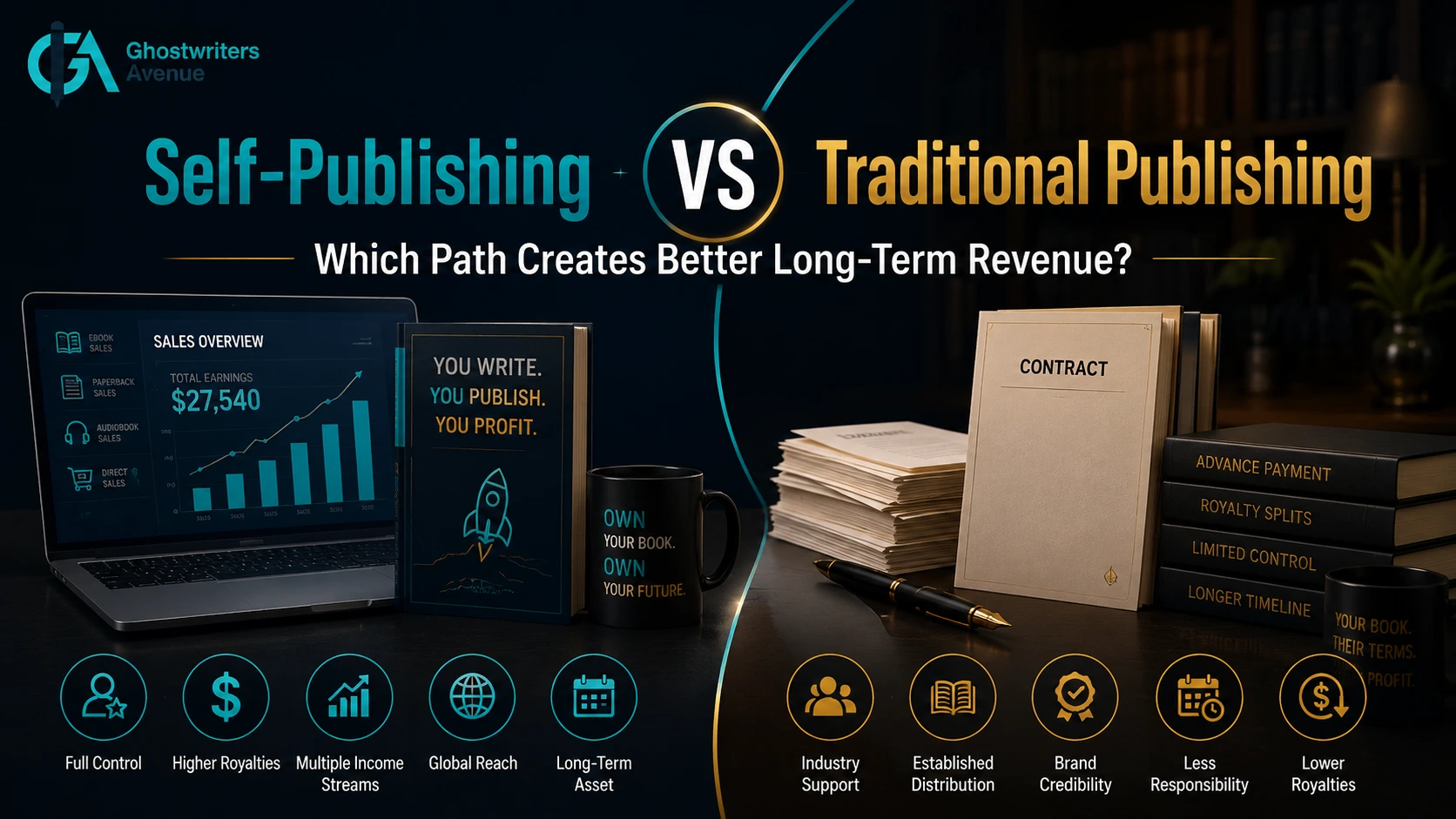
When you strip away the prestige, the marketing language, and the emotional pull of each path, the self-publishing vs traditional publishing question comes down to one core trade-off. Do you want more money per book sold with full control, or do you want the infrastructure and credibility of a traditional publisher with lower per-unit earnings?
For authors focused on long-term revenue, self-publishing wins on the math almost every time. Higher royalty rates, faster publication timelines, perpetual rights ownership, and pricing flexibility all compound over a catalog of titles to create income potential that traditional publishing rarely matches for mid-list authors.
The exception is the author who secures a transformative advance from a major publisher, benefits from aggressive marketing support, and breaks into bestseller territory. For that author, the traditional path can be equally or more rewarding. But that outcome applies to a small fraction of submissions, and betting your career on it without a backup strategy is a significant risk.
The authors we work with who build the most consistent long-term revenue are the ones who treat their books as assets, invest in professional production regardless of which path they choose, and stay focused on building an audience rather than chasing a publishing deal as an end in itself.
Frequently Asked Questions
The Path That Pays Is the One You Plan For
There is no universally correct answer in the self-publishing vs traditional publishing debate, but there is always a correct answer for your specific situation. The authors who thrive are not necessarily the ones who chose the right path from the beginning. They are the ones who understood what each path required, planned accordingly, and treated their book as both a creative work and a long-term revenue asset.
Whichever direction you choose, professional support makes the difference between a book that gets lost in the marketplace and one that builds your career. Ghostwriters Avenue helps authors navigate both paths with end-to-end writing, publishing, and marketing services designed to maximize the long-term value of every book you publish.